Latest updates (see the updates page for more detail)
- 2026-10-15 - Added write-up of a proposal for large-scale solar irrigation system in VIP's impact area.
- 2026-09-29 - We have received The Rotary Foundation's grant funds. VIP has shared their September Progress Report: Water testing is complete, and quality is good. Water Point Committees have been trained. Signage is being constructed at each borehole.
- 2026-09-02 - August Progress Report from VIP: Two more hydro surveys have been done, and two more wells have been drilled--with success! Read more in VIP's August progress report.
- 2026-09-01 - The Rotary Foundation has released our grant funds! All contingencies have been met.
- 2026-08-20 - The grant is fully funded. All pledged funds have been collected, which is the final contingency that TRF needs to be met in order to release grant funds to the project.
- 2026-08-19 - Received a Progress Report (June) from VIP: Five wells have been drilled! Three are "wet" (Maliwata, Mwala, and Manduwasa villags), one is "damp" (Makaluni village), and one, unfortunately is dry (Maulana village). Read more in VIP's June progress report.
- 2026-08-14 - Rich Daesener, VIP's Director of Strategic Partnerships, shared about completion of a well we are sponsoring in Maliwata.
- 2026-08-06 - TRF has received the water survey results, and has lifted the corresponding contingency.
- We are planning another well-drilling WASH grant for 2026-27.
Water for Malawi
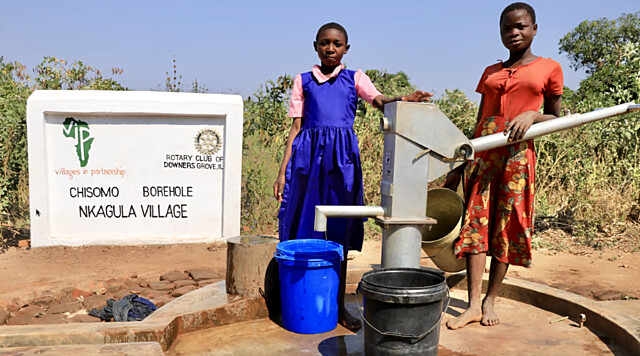 A completed well for Chisomo and Nkagula Villages
The Rotary Club of Downers Grove is working with The Rotary Club of Blantyre, Malawi and with Villages In Partnership to bring water to the rural villages of Southern Malawi.
In 2021, the Downers Grove Club initiated a global WASH grant in partnership with the Blantyre Rotary Club and Villages In Partnership (VIP) to drill five borehole wells in the Zomba region of Southern Malawi.
Striking water in Chidule on the third attempt!
In 2024 and 2025, the Downers Grove Club sponsored drilling of four more wells in the same region, this time through directly supporting VIP.
In the 2025-2026 Rotary year, the Downers Grove Club Foundation Committee wrote another grant very much like the first one: Same size (5 wells), same partners (Blantyre Rotary and VIP), same area (Zomba), and the same focus on borehole wells as a foundational and community-chosen resource for moving from scarcity to sustainability.
Why Malawi
Malawi is consistently identified as one of the poorest countries in the world. While facing significant economic challenges, it has avoided the severe conflict and violence seen in other low-GDP countries.
Its resilient people suffer from a form of extreme poverty not seen anywhere in the U.S. The statistics are staggering and difficult to fathom. Many families, especially in VIP's rural partner villages, eat only what food they are able to grow. With local government unable to provide any form of safety net, many Malawians live on a knife-edge, with one bad harvest, one illness, or one accident often making the difference between life and death.
Why Villages In Partnership
Villages In Partnership is a strong, well-established, trusted partner in their chosen area of focus: the Zomba region of Malawi.
VIP concentrates on six Critical Resources: Water, Food Security, Education, Healthcare, Infrastructure, and Economic Opportunity. They have six U.S. staff and 22 Malawi staff.
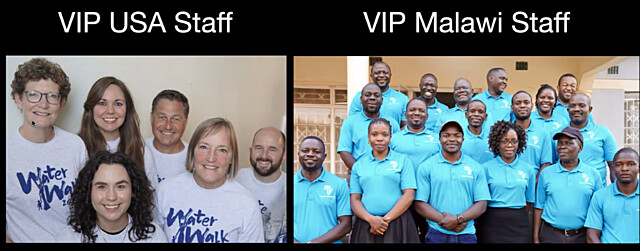 VIP Staff
Harry McCabe, a Rotarian since 1978, is familiar with Rotary's global grant process. Harry became aware of VIP's work through friendships in Christ Church of Oakbrook, and realized that VIP's six mission areas correspond closely to Rotary's Seven Areas of Focus.
Why Water?
The methodology VIP uses for gathering information from community members relies on Participatory Rural Appraisal (PRA), an inclusive and community-driven approach that empowered villagers to lead the process and share their knowledge directly.
From the PRA exercises the consensus almost always emerges that above all, community members urgently need clean, safe, and reliable water close to home. They describe how far-away safe water forces them to alternatively use rivers, streams and unprotected shallow wells, which exposes them to contamination and leads to frequent waterborne ailments like cholera, diarrhea, and typhoid, which are especially devastating for children. Many highlight reduced disease incidences as a top priority, noting that safer water close to home would mean fewer sick days, lower medical costs, and healthier families overall who participate fully and meaningfully in development work taking place in their locality.
Scarcity to Sustainability
VIP's mission is to empower communities in Malawi to rise from scarcity to sustainability by equipping them with the critical resources they need. Close, clean water is foundational to this journey.
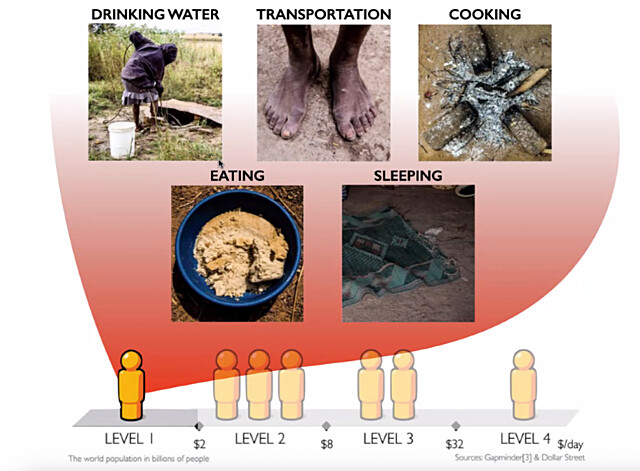 Scarcity - Attributes of Level-1 Poverty
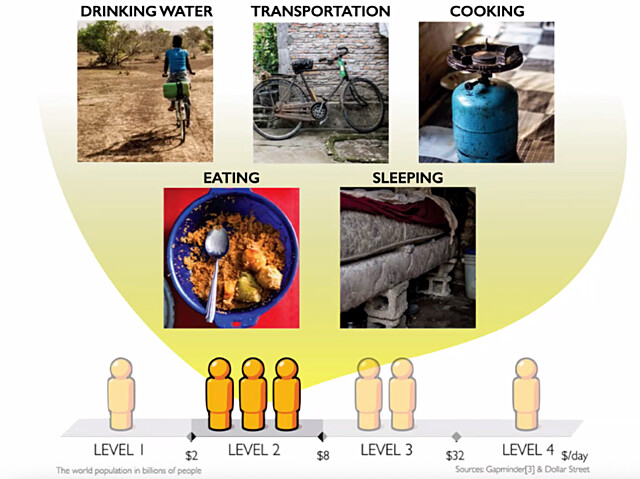 Sustainability - Attributes of Level-2 Poverty
Expected Impact
Clean, Close, Reliable Water Sources
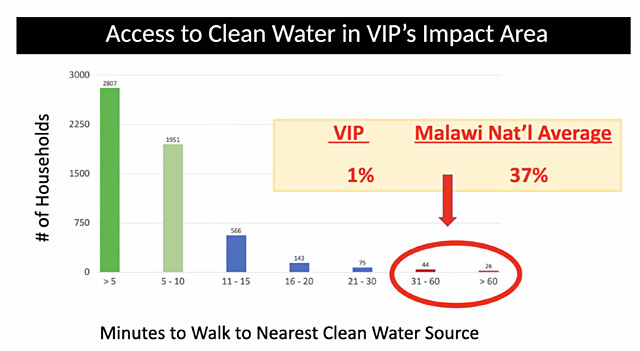
For our current global grant application, VIP has identified five villages that face a shortfall of Malawi’s standard of one borehole serving 50 households, amounting to a gap of about seven boreholes.
- Manduwasa (460 people)
- Makuluni (635 people)
- Mmwala (1,405 people)
- Maulana (890 people)
- Maliwata (1,135 people)
Altogether, the five new boreholes will benefit a total of about 1,000-1,250 people.
Economic and Social Justice
A nearby well can transform the social structure of a community for the better, especially for women and girls.
Girls no longer have to spend large portions of their day fetching water and can go to school.
Women similarly can spend freed-up time engaging in economic opportunities more suited to their capabilities and goals.
Why a Global Grant
Why don't we just give money directly to VIP instead of going to all the (considerable!) trouble of writing and executing a global grant from the Rotary Foundation?
- The global grant process has the potential to unlock large amounts of matching funds, by seeking District Designated Funds (DDF) to fund the project. All DDF given from Rotary clubs and districts is matched 80% by the World Fund.
- Rotary has a highly developed worldwide system for connecting networks of partners in doing good.
- The global grant process includes built-in safeguards for protecting the integrity of Rotary and our partners.
- The Rotary Foundation's vast experience implementing successful sustainable humanitarian projects is brought to bear in the process of writing of a global grant.